
Editors Pick, Mindset
Written by the MindGrowth Insights Editorial Team
Published: July 15, 2026 · Last updated: July 15, 2026
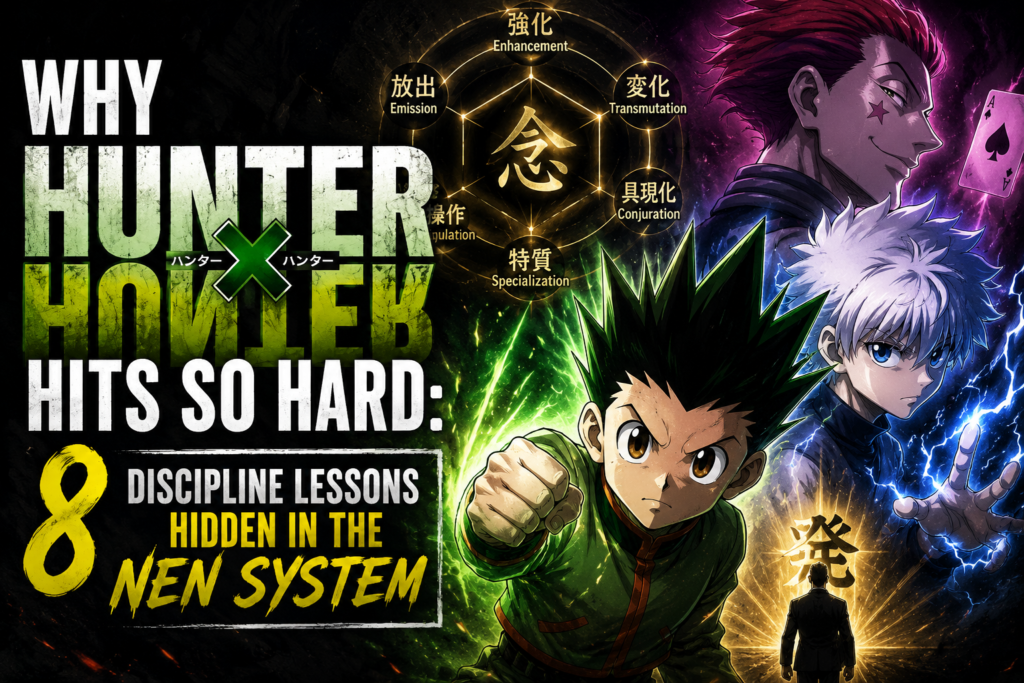
Editorial Note: This article is commentary and analysis inspired by Hunter x Hunter, created by Yoshihiro Togashi. It is intended for educational and informational purposes, highlighting themes and practical applications, and is not official material from the author or publisher. Character and plot details referenced here were cross-checked against the source material and published fan-reference sources to keep them accurate.
Hunter x Hunter does not reward viewers who skip the boring parts. Some of its most important arcs are about characters sitting still, breathing, and repeating the same exercise for weeks before anything visibly changes.
That patience is the point.
Where most shonen series treat power as something that arrives in a dramatic flash, Hunter x Hunter treats it as something earned through unglamorous repetition — and through the discipline to know when to push, when to rest, and when to let go of something that’s poisoning you from the inside.
These Hunter x Hunter discipline lessons aren’t about becoming a Hunter or learning Nen. They’re about what the series keeps insisting, arc after arc: real strength is built in the parts nobody’s watching, and it can be undone in a single moment of losing control.
Key Takeaways
Mastery starts with boring fundamentals, not talent — Biscuit Krueger makes Gon and Killua drill the basic Nen principle of Ten long before they’re allowed to do anything impressive.
Rest and restraint (Zetsu) are as much a skill as output — and the research on burnout backs that up.
Unprocessed grief has a real, permanent cost — Gon’s reaction to Kite’s death shows what happens when rage takes the wheel.
Breaking free of someone else’s conditioning (Killua and his brother Illumi) is its own kind of strength.
Long-term mastery, like Netero’s decades of training, looks more like devotion than talent.
1. Master the Basics Before You Chase Power
When Wing first introduces Gon and Killua to Nen, he doesn’t teach them a flashy technique. He teaches them Ten — the simple discipline of holding a steady layer of aura around your body, all day, without thinking about it. Later, their mentor Biscuit Krueger makes them drill Ten for weeks before touching anything advanced, even though both boys are impatient to do more.
Most people skip this step in real life too. They want the advanced version of a skill before the boring version is automatic — the negotiation tactics before the daily habit of showing up prepared, the elite workout before consistent sleep and basic movement.
Ten looks like nothing from the outside. That’s exactly why most people never build it.
2. Energy Follows Discipline, Not Talent
Nen isn’t random — it’s explicitly modeled on real-world ideas like Qi and Chakra, philosophies built around the idea that focused, controlled energy comes from training the mind as much as the body. The show treats power as a byproduct of discipline, not a personality trait some characters happen to have.
This tracks with what research on deliberate practice has found in real skill development: consistent, focused, uncomfortable repetition — not raw talent — is what separates experts from everyone else who “practices” casually.
Talent decides your starting point. Discipline decides how far you get from there.
3. Zetsu: Knowing When to Go Quiet Is a Skill Too
Zetsu — the Nen principle of suppressing your aura completely — gets treated in the story as seriously as offense. Characters who never learn to power down stay exhausted, exposed, and easy to read.
In real life, this shows up as the person who’s “on” constantly — always visible, always performing productivity — and quietly burning out because they never learned the discipline of switching off. Guidance from the American Psychiatric Association points to the same pattern: consistent recovery, not just working harder, is what actually protects against burnout.
Rest isn’t the absence of discipline. Sometimes it’s the most disciplined move available.
4. Calculated Courage Beats Blind Caution
Killua enters the story trained to run from any fight he isn’t certain to win — a habit drilled into him by his family. Biscuit eventually confronts this directly, pointing out that his caution isn’t wisdom; it’s fear wearing wisdom’s clothes, and it’s capping how strong he can become.
This distinction matters in ordinary life too. There’s a real difference between thoughtful risk assessment and using caution as a permanent excuse to never test yourself against something bigger.
If you’d like the counterpoint — what happens when fear runs the other direction and someone charges in without any restraint at all — our Attack on Titan discipline lessons piece covers that side of the same coin.
5. Unprocessed Grief Has a Real Cost
After Kite is killed, Gon’s grief curdles into an obsession with forcing the Chimera Ant Neferpitou to bring him back. He isn’t written as heroic in this arc — he’s written as someone whose pain has taken the controls. The cost is permanent: Gon burns through his own life force and, for a long stretch, loses the ability to use Nen at all.
This mirrors something APA’s own research reporting touches on: anger that goes unprocessed doesn’t just disappear, it tends to resurface, often at a cost to the person carrying it.
The story isn’t subtle about the lesson: feeling grief is human, but letting it drive every decision has a bill attached, and the person who pays it is you.
6. Cut the Needle Someone Else Put in You
Killua’s family conditioned him from childhood to associate fear with obedience — literally, in the story, through a needle implanted in his brain by his older brother Illumi to suppress his own instincts. Part of Killua’s arc is the slow, deliberate work of removing that influence and deciding for himself who he wants to be.
Most people carry a version of this — an inherited belief about what they’re capable of, installed early by someone else’s expectations, that they’ve never actually questioned.
Killua doesn’t get free by accident. He gets free by noticing the needle was there at all.
7. Mastery Is a Decades-Long Practice, Not a Talent
Chairman Netero’s fighting style, born from a lifetime of martial arts and quiet daily devotion, is treated by the story as the product of sheer accumulated years — not a gift. His signature ability is even framed, visually, as an act of prayer: gratitude repeated so many times it became power.
It’s a useful correction to how most people picture mastery — as a moment of arrival rather than a practice repeated so often it eventually looks like talent from the outside.
8. Find a Nen Partner, Not Just a Rival
Gon and Killua’s bond, formed the moment they meet during the Hunter Exam, isn’t just friendship for its own sake — it functions as a working system. They train together, correct each other’s blind spots, and each becomes measurably better at Nen because the other one is watching.
For a deeper look at what that kind of mutual accountability looks like when it’s explicitly about leadership rather than friendship, our piece on Naruto’s path to Hokage explores the same dynamic from a different angle.
FAQ
Is Nen based on anything real?
Not literally — nobody can suppress or project aura. But creator Yoshihiro Togashi has said it draws on real philosophical concepts like Qi and Chakra, which is part of why the training feels more grounded than most anime power systems.
What do Ten, Zetsu, Ren, and Hatsu actually mean?
They’re the four foundational Nen principles: Ten (maintaining a steady aura), Zetsu (suppressing it completely), Ren (intensifying it), and Hatsu (shaping it into a unique ability). Characters are expected to master them roughly in that order.
What’s the deeper theme running through Hunter x Hunter?
Beneath the adventure plot, most arcs return to the same idea: strength without self-control is dangerous, and real growth usually looks like patience, not power spikes.
Final Reflection
The deepest Hunter x Hunter discipline lessons don’t promise that consistency feels exciting. Ten doesn’t feel exciting. Weeks of Zetsu practice doesn’t feel exciting. Neither does staying calm when someone you love is in danger.
But the story keeps making the same point, from Gon’s collapse to Netero’s decades of quiet prayer: the fundamentals you’re tempted to skip are usually the entire game.
You won’t get a flashy power-up for showing up on the boring days. You’ll just get better — quietly, then all at once.
Further Reading on MindGrowth Insights
Mindset: Why Attack on Titan Hits So Hard: 10 Discipline Lessons Hidden in the Story
Career: Why Naruto Became Hokage: 10 Leadership Lessons for Becoming a Better Manager
Mindset: The Willpower Instinct: 5 Self-Control Lessons
Mindset: Grit: How to Build Perseverance