
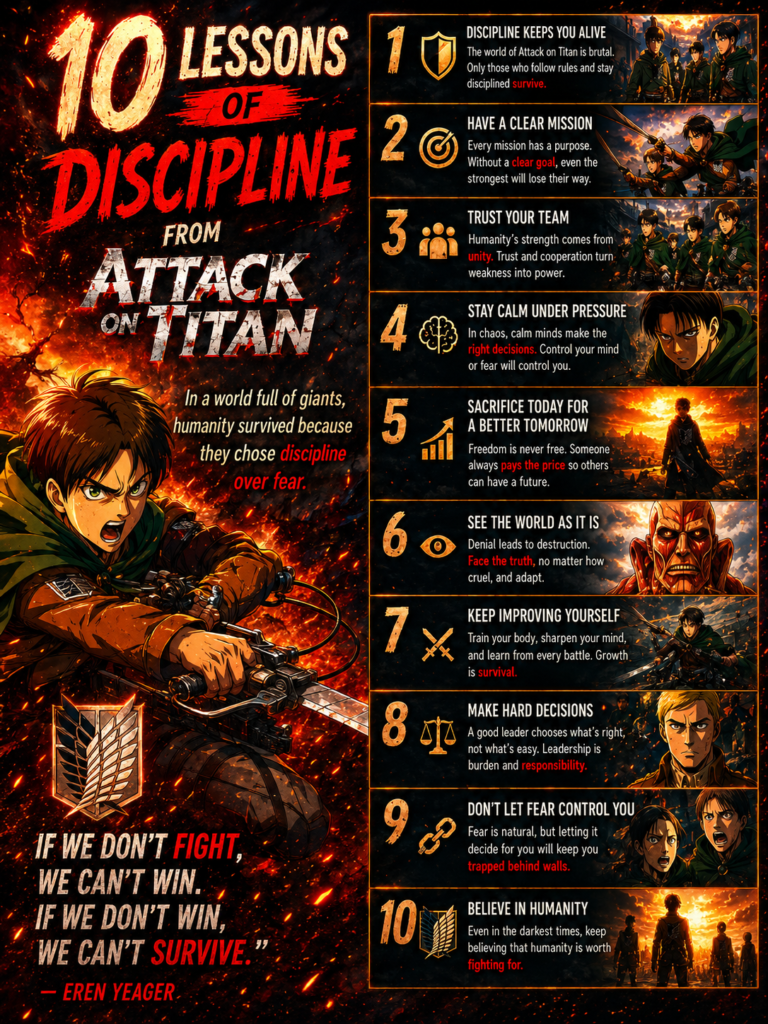
Attack on Titan is not a comfortable story. It is heavy, tense, and filled with impossible decisions.
But that is exactly why its lessons feel different.
Unlike stories where growth feels exciting and heroic, Attack on Titan shows discipline under pressure. It asks what people become when fear is constant, when choices are unclear, and when survival depends on more than strength.
The world of the story is extreme, but the emotional lessons are surprisingly real. We may not live inside walls or face giant enemies, but we do face pressure, uncertainty, fear, responsibility, and moments where avoiding reality only makes life smaller.
These Attack on Titan discipline lessons are not about violence. They are about mental strength, leadership, courage, teamwork, and the difficult maturity required to keep moving when life feels bigger than you.
Discipline Keeps You Alive
In Attack on Titan, discipline is not decoration. It is survival.
Characters who ignore training, strategy, or responsibility put themselves and others at risk. This creates one of the clearest lessons of the story: discipline matters most when pressure is high.
In everyday life, discipline may not feel urgent. Skipping a habit, avoiding a conversation, delaying a responsibility, or ignoring a weakness may seem harmless at first. But over time, small acts of avoidance create larger problems.
Discipline protects your future self.
It prepares you before the crisis arrives. It gives you structure when emotions become loud. It keeps you from making every decision based on fear or impulse.
A disciplined life is not a perfect life.
It is a life with fewer unnecessary collapses.
Have a Clear Mission
One reason the characters in Attack on Titan endure so much is that they have a mission. They may disagree, struggle, and doubt themselves, but they are not moving randomly.
A clear mission gives direction to fear.
Without a mission, fear becomes scattered. You overthink everything. You chase distractions. You react to every problem as if it deserves equal attention.
With a mission, you know what matters most.
In real life, your mission does not need to be dramatic. It may be to build a better future, support your family, master a craft, become a stronger leader, or live with more integrity.
The important thing is clarity.
Discipline becomes easier when your mind knows what it is protecting.
Trust Your Team
Attack on Titan repeatedly shows that individual courage is not enough. Survival depends on coordination, trust, and shared responsibility.
This is one of the most practical Attack on Titan discipline lessons, especially for work, leadership, and relationships.
Many people want to be strong alone. They think asking for help is weakness. They carry too much, communicate too little, and quietly resent others for not understanding what they never explained.
But teamwork requires discipline.
It requires listening. It requires reliability. It requires doing your part even when nobody praises you. It requires trusting others without controlling every detail.
A strong team is not made of perfect people.
It is made of people who understand that the mission matters more than ego.
Stay Calm Under Pressure
Pressure reveals the quality of your mind.
When things are easy, almost anyone can appear disciplined. But when plans break, emotions rise, and the outcome is uncertain, your inner habits become visible.
In Attack on Titan, panic often makes situations worse. Calm does not guarantee success, but it creates space for better decisions.
That lesson applies everywhere.
In school, work, family, leadership, or personal growth, pressure will come. You may face deadlines, conflict, disappointment, or sudden change. The goal is not to feel nothing. The goal is to avoid letting fear make your decisions for you.
Calm is not passive.
Calm is active control.
It is the ability to breathe, observe, think, and choose while your emotions are demanding a reaction.
Sacrifice Today for a Better Tomorrow
The story often explores sacrifice, but the everyday version of this lesson is not extreme. It is about giving up short-term comfort for long-term meaning.
Every serious goal asks for sacrifice.
To build skill, you sacrifice distraction.
To become healthier, you sacrifice some impulses.
To become a better leader, you sacrifice the need to always be right.
To grow emotionally, you sacrifice the comfort of blaming everyone else.
Discipline is the art of paying a small price today so you do not pay a much larger price later.
But sacrifice should not mean losing yourself completely. Healthy discipline is not self-destruction. It is choosing what matters most with honesty.
The question is not, “How much can I suffer?”
The better question is, “What am I willing to give up for the life I say I want?”
See the World as It Is
One of the hardest lessons in Attack on Titan is the danger of illusion.
The characters often have to confront truths they did not want to see. That is painful, but necessary. You cannot respond wisely to reality if you are committed to denying it.
In real life, many people avoid the truth because truth creates responsibility.
If you admit a habit is hurting you, you have to change it.
If you admit a relationship is unhealthy, you have to set boundaries.
If you admit you are unprepared, you have to train.
If you admit your dream matters, you have to stop treating it casually.
Seeing clearly is uncomfortable because it removes excuses.
But it also returns your power.
You cannot improve a life you refuse to look at honestly.
Keep Improving Yourself
In Attack on Titan, training is not optional. The world is too demanding for careless growth.
Your world may not be as extreme, but the principle remains: if you want better outcomes, you must become more capable.
This does not mean you are not enough as a person. It means your abilities need to match your ambitions.
Wanting more without improving yourself creates frustration. You want the result, but you have not built the capacity. Discipline closes that gap.
Read more carefully.
Practice more deliberately.
Communicate more clearly.
Recover more wisely.
Pay attention to your patterns.
Self-improvement is not about hating who you are. It is about respecting your potential enough to develop it.
Make Hard Decisions
Leadership in Attack on Titan is rarely simple. The story often shows that responsibility involves difficult choices, limited information, and emotional weight.
This is a mature lesson: discipline is not only about habits. It is also about decision-making.
Many people avoid hard decisions because they do not want to feel guilty, uncertain, or misunderstood. So they delay. They wait for perfect clarity. They hope the problem solves itself.
But avoiding a decision is often still a decision.
A disciplined person does not rush carelessly, but they also do not hide forever. They gather information, consider consequences, accept discomfort, and choose as wisely as they can.
Leadership is not proven by always knowing the perfect answer.
Sometimes it is proven by having the courage to act when there is no painless option.
Do Not Let Fear Control You
Fear is everywhere in Attack on Titan. That is what makes courage meaningful.
Courage is not the absence of fear. It is movement in the presence of fear.
This matters because many people wait to feel fearless before they act. They think confidence must come first. But confidence often comes after action, not before it.
You may feel afraid to speak up.
Afraid to begin.
Afraid to fail.
Afraid to be judged.
Afraid to outgrow an old identity.
Discipline does not remove the fear immediately. It simply refuses to let fear become the owner of your life.
Fear can warn you.
But it should not imprison you.
Believe in Humanity
Despite its darkness, Attack on Titan continues to ask whether people are worth fighting for, trusting, and protecting.
That question matters beyond the story.
It is easy to become cynical. When people disappoint you, when systems feel unfair, when conflict seems endless, it can feel intelligent to stop caring.
But cynicism is not always wisdom.
Sometimes it is wounded hope wearing armor.
Believing in humanity does not mean ignoring cruelty, mistakes, or weakness. It means refusing to let darkness become your entire worldview.
Discipline includes protecting your ability to care.
To keep empathy alive.
To keep building.
To keep choosing responsibility instead of bitterness.
A person who still cares after seeing difficulty has a rare kind of strength.
Final Reflection
The deepest Attack on Titan discipline lessons are not easy or comfortable. They do not promise that life will always reward effort quickly. They do not pretend courage feels clean. They do not simplify leadership into confidence and applause.
Instead, they show something more serious.
Discipline is what remains when motivation is gone.
It is the structure you rely on when fear rises.
It is the clarity that helps you move when the world feels uncertain.
It is the loyalty to your mission, your team, your values, and the future you are trying to protect.
In real life, you may not face the dramatic battles of a fictional world. But you will face moments that ask who you are under pressure.
You will face fear.
You will face responsibility.
You will face truths you would rather avoid.
And in those moments, discipline will not feel glamorous.
It will feel like choosing the next right action when your emotions want to run.
That quiet choice is where strength begins.