
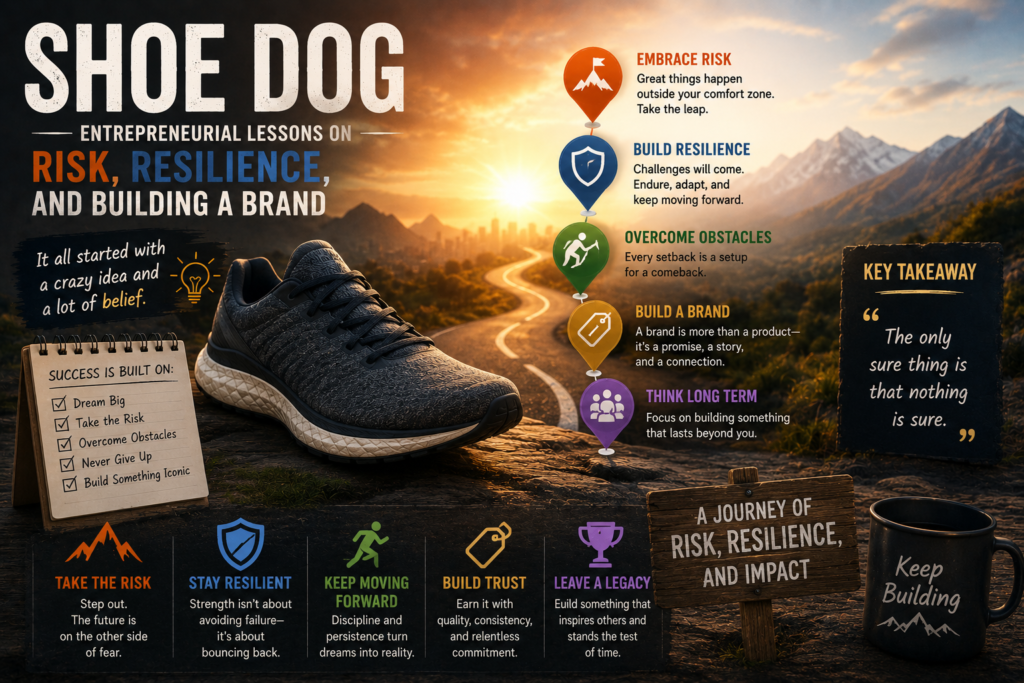
Editorial Note: This article is a summary and commentary on Shoe Dog by Phil Knight. It is intended for educational and informational purposes, highlighting key lessons and practical applications from the book. Simon & Schuster describes Shoe Dog as Phil Knight’s memoir about Nike’s early days and its growth from a startup into a major global brand.This article is not official material from the author or publisher.
Introduction
Entrepreneurship is often presented as glamorous: a bold idea, fast growth, and a clean path to success. Shoe Dog by Phil Knight offers a more grounded picture.
The book shows that building a company can be uncertain, stressful, and deeply personal. It is not only about strategy. It is about persistence, relationships, timing, risk, and belief.
For readers interested in business, career growth, and personal development, Shoe Dog matters because it reveals the human side of entrepreneurship. Big brands may look inevitable after they succeed, but their early years are often fragile.
Why This Book Matters
Shoe Dog matters because it reminds readers that success is rarely as smooth as it looks from the outside. Behind many respected companies are years of doubt, financial pressure, mistakes, and difficult decisions.
This perspective is useful for anyone trying to build something meaningful. A business, career, creative project, or personal goal may look messy before it works.
The book also shows that entrepreneurship is not just about having an idea. It is about staying committed through uncertainty while continuing to learn and adapt.
Key Lesson 1: Start Before Everything Feels Perfect
One of the strongest lessons from Shoe Dog is that progress often begins before conditions are ideal. Waiting for complete certainty can stop a person from ever starting.
Many aspiring entrepreneurs delay action because they want the perfect plan, perfect funding, or perfect confidence. But real learning often comes from movement.
Starting does not mean being reckless. It means taking a thoughtful first step and learning from the response.
For personal growth, this lesson is powerful. You do not need to feel completely ready to apply for a new role, launch a project, or develop a new skill. You need a responsible starting point.
Harvard Business Review cites research showing that 75% of startups fail, which supports the idea that waiting for perfect certainty is unrealistic. Waiting for perfect confidence can become a hidden form of fear. In fact, the Global Entrepreneurship Monitor found that 49% of people surveyed said fear of failure would stop them from starting a business.
“Perfection often feels like preparation, but sometimes it is just fear wearing better clothes.”
Key Lesson 2: Risk Should Be Respected, Not Worshiped
Entrepreneurship involves risk, but Shoe Dog does not make risk look easy. The better lesson is that risk should be understood and managed.
Some people romanticize risk as if boldness alone creates success. In reality, smart risk requires preparation, persistence, and awareness of consequences.
Before taking a major risk, ask: What could go wrong? What resources do I need? What is the next best step? What would make this risk more manageable?
This approach applies to business and career decisions. Changing jobs, starting a business, or investing time into a new path should involve both courage and clear thinking.
The U.S. Bureau of Labor Statistics found that only 34.7% of private-sector businesses born in 2013 were still operating in 2023, showing how real business risk is.
“Smart people do not avoid risk completely. They learn how to measure it before they move.”
Key Lesson 3: Build Relationships That Can Survive Pressure
A company is not built by one person alone. Relationships matter: partners, employees, suppliers, customers, mentors, and supporters.
The book’s broader lesson is that trust becomes especially important when circumstances are difficult. When money is tight, deadlines are urgent, or plans change, weak relationships can break. Strong relationships can help people keep moving.
In business, this means treating people with respect before you need help. It means communicating clearly, honoring commitments, and choosing partners carefully.
For career development, relationships are also essential. A strong network is not only about opportunity. It is about learning, support, and shared growth.
Gallup reports that in the U.S., only two in 10 employees say they have a best friend at work, yet having a close work friend is strongly linked to engagement, retention, innovation, and performance.
“Some connections are only strong in sunshine. Choose the ones that know how to stand in storms.”
Key Lesson 4: Brand Is Built Through Meaning and Consistency
Nike became more than a product company because it connected with identity, performance, and aspiration. The broader lesson is that strong brands stand for something.
A brand is not only a logo or slogan. It is the feeling people associate with a company based on repeated experiences.
For small businesses and professionals, this lesson is practical. Your brand is shaped by how you show up consistently. Are you reliable? Clear? Creative? Helpful? Focused?
Personal branding works the same way. People remember patterns. If you consistently deliver value, your reputation strengthens over time.
Marq report says 85% of organizations have brand guidelines, but only 30% consistently enforce them.
“Meaning gives your brand a soul. Consistency gives it memory.”
Key Lesson 5: Resilience Is Built Through Repeated Recovery
The path in Shoe Dog includes uncertainty and setbacks. That is part of what makes the story useful. Resilience is not a personality trait reserved for a few people. It is built through repeated recovery.
Every setback creates a choice: quit, deny the problem, or learn and adjust. Resilient people and teams do not avoid difficulty. They develop the ability to respond.
This matters in business because plans rarely unfold exactly as expected. Customer behavior changes. Costs rise. Partners leave. Competitors improve.
The goal is not to avoid every problem. The goal is to become better at adapting.
The American Psychological Association explains that resilience is not a fixed trait; it involves behaviors, thoughts, and actions that people can learn and develop.
“Resilience is the quiet skill of returning to yourself after life shakes you.”
How to Apply These Lessons in Daily Life
Choose one idea you have been delaying and define the smallest responsible first step. This could be researching a market, building a simple prototype, asking for feedback, or scheduling time to work.
Next, identify the real risks. Write them down without exaggerating them. Then decide how to reduce the most important risks.
Also, invest in relationships before you need them. Reach out to someone you respect. Offer value. Ask thoughtful questions. Stay connected.
Finally, build consistency. Whether you are building a business or a career, decide what you want to be known for and act in alignment with that reputation.
Common Mistakes to Avoid
One mistake is assuming successful companies were destined to succeed. This can make your own messy beginning feel like failure. In reality, uncertainty is normal.
Another mistake is confusing passion with a plan. Passion can start the journey, but systems, learning, and discipline help sustain it.
A third mistake is ignoring relationships. No founder, professional, or creator succeeds completely alone.
Final Thoughts
Shoe Dog is valuable because it makes entrepreneurship feel human. It shows that building something meaningful often involves risk, doubt, persistence, and imperfect decisions.
For MindGrowth Insights readers, the key takeaway is encouraging but realistic: your path does not need to look polished to be meaningful. Progress often begins with uncertainty, grows through consistency, and survives through resilience.
Apply This Today
Choose one idea you have delayed and define the smallest next step.
Write down three risks and one way to reduce each.
Identify one relationship you can strengthen this week.
Recommended Reading
Shoe Dog by Phil Knight.
Internal Link Suggestions
Productivity: Getting Things Done: Simple Ways for Stress-Free Productivity
Career: What Color Is Your Parachute? 5 Powerful Career Lessons
Finance: Money for Couples: Building a Shared Financial Life
Mindset: Secrets of the Millionaire Mind: Money Mindset for Building Wealth Awareness