
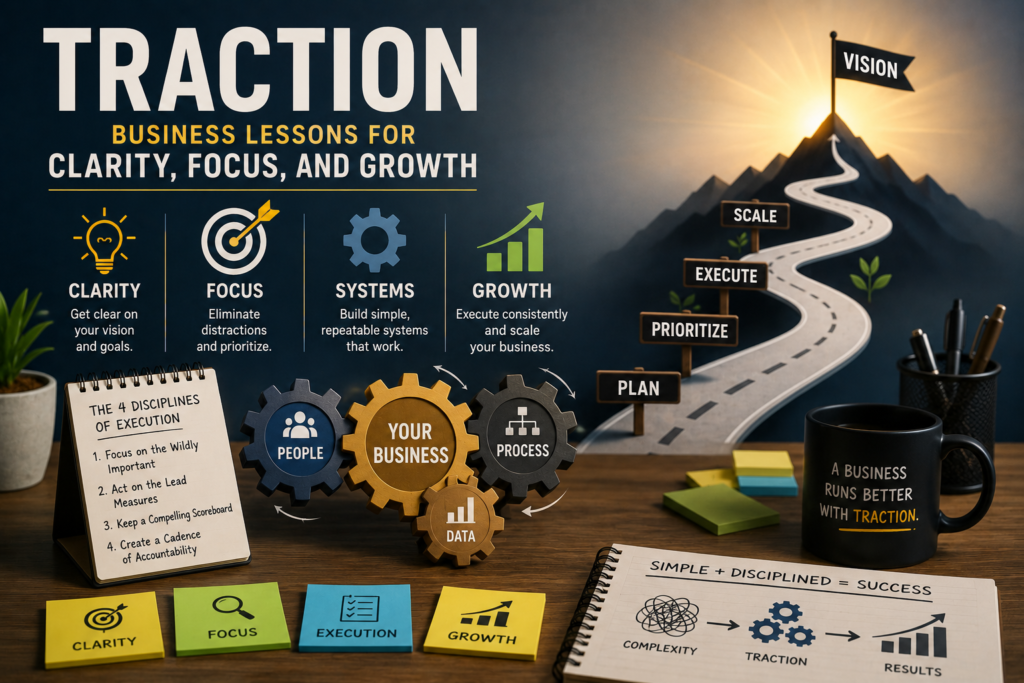
Editorial Note: This article is a summary and commentary on Traction by Gino Wickman. It is intended for educational and informational purposes, highlighting key lessons and practical applications from the book. EOS Worldwide describes Traction as a book about strengthening key components of a business and creating more focus and growth. This article is not official material from the author or publisher.
Introduction
Many businesses do not struggle because the founder lacks passion. They struggle because the company lacks structure.
Traction by Gino Wickman is built around a practical idea: a business needs a clear operating system. Without one, teams may work hard but still feel stuck, reactive, and misaligned.
For entrepreneurs, managers, and professionals, the book’s lessons are valuable because they focus on execution. Vision matters, but vision without discipline often becomes frustration.
What EOS Means in Traction by Gino Wickman
A key idea behind Traction is the Entrepreneurial Operating System, often called EOS. In simple terms, EOS is a practical way to run a business with more clarity, accountability, and discipline.
Instead of treating business growth as a vague goal, EOS breaks the company into core areas that leaders can strengthen. The point is not to make the business more complicated. The point is to make the business easier to understand, easier to manage, and easier to improve.
For a growing company, this matters because confusion often hides in ordinary places: unclear roles, too many priorities, weak meetings, inconsistent processes, or decisions based only on opinion. EOS gives leaders a shared language for solving those problems.
Why This Book Matters
Small and growing businesses often face similar problems. The team is busy, but priorities are unclear. Meetings happen, but decisions do not stick. Leaders have ideas, but accountability is inconsistent.
Harvard Business Review has reported that many leaders view meetings as inefficient, which supports one of Traction’s key lessons: meetings need structure, purpose, and clear decisions to be useful.
Leaders increasingly recognize that most meetings are counterproductive, with studies from the Harvard Business Review showing that up to 71% of senior managers view them as inefficient
Traction matters because it turns business improvement into a system. It encourages leaders to clarify where the business is going, define who owns what, measure progress, and solve problems directly.
This is helpful for business owners, but it is also useful for anyone managing projects or teams. The principles can improve how people organize work, communicate priorities, and follow through.
The Six Key Components of EOS Explained Simply
| EOS component | What it means in practice |
|---|---|
| Vision | Everyone understands where the business is going and how it plans to get there. |
| People | The business has the right people in the right roles. |
| Data | Leaders use a few meaningful numbers to see what is really happening. |
| Issues | Problems are identified, discussed honestly, and solved at the root. |
| Process | Core ways of working are documented and followed consistently. |
| Traction | The team turns plans into execution through priorities, accountability, and rhythm. |
The value of these components is that they connect strategy with daily behavior. A company can have a strong vision, but without people, data, process, and accountability, that vision may never become consistent execution.
Key Lesson 1: Vision Must Be Shared, Not Just Stated
A vision that lives only in the founder’s head is not enough. For a team to execute well, people need to understand the destination.
Shared vision includes answers to practical questions. What does the business stand for? Who does it serve? What are the priorities? What does success look like?
When vision is unclear, people make decisions based on personal assumptions. That creates inconsistency.
A shared vision helps the team make better everyday choices. It also gives employees a stronger sense of purpose because they can connect their work to a larger direction.
“A vision that only lives in the founder’s mind cannot guide a team.”
Key Lesson 2: Accountability Needs Clear Ownership
One of the most practical lessons from Traction is that accountability improves when ownership is visible.
In many organizations, tasks fall through the cracks because everyone assumes someone else is responsible. Clear ownership reduces this problem.
This does not mean blaming people. It means assigning responsibility so progress can be tracked and support can be provided.
For leaders, this requires courage. It is easier to keep roles vague, especially in a small team where people help with many things. But vague responsibility often creates confusion and resentment.
A useful question is: “Who owns this outcome?” If the answer is unclear, accountability is weak.
“Clear ownership turns responsibility into action.”
Key Lesson 3: Metrics Help Leaders See the Business Clearly
Businesses often rely too much on feelings. A leader may feel that sales are improving, customers are happy, or the team is productive. But feelings are not enough.
Metrics provide visibility. They help leaders identify trends, spot problems early, and make better decisions.
The key is to measure what truly matters. Too many metrics can create noise. The right metrics create focus.
For a small business, useful measurements may include lead flow, customer retention, cash position, project completion, or team capacity. The best metrics depend on the business model.
For individuals, the same idea applies. If you want to improve your career, track applications, networking conversations, completed projects, or learning hours.
“What leaders do not measure, they often misunderstand.”
Key Lesson 4: Meetings Should Create Decisions, Not Just Discussion
Many people dislike meetings because meetings often waste time. Traction encourages a more disciplined approach.
A productive meeting has a purpose, a structure, and clear outcomes. People should leave knowing what was decided, who owns the next steps, and when progress will be reviewed.
This is a powerful lesson for any workplace. Meetings should not exist just because they are on the calendar. They should help the team solve issues and maintain alignment.
Better meetings also respect people’s time. When discussions stay focused, teams can move faster.
“The real test of a meeting is not how much was discussed, but what became clearer because of it.”
Key Lesson 5: Solve Issues at the Root
Businesses often treat symptoms instead of causes. For example, a missed deadline may look like a time-management issue, but the root cause could be unclear priorities, poor handoffs, or lack of training.
Strong teams learn to identify, discuss, and solve real issues. This requires honesty. People must be willing to bring problems into the open.
Avoiding issues may protect comfort temporarily, but it creates bigger problems later. A healthy business culture makes problem-solving normal.
For personal growth, this lesson is also useful. If you repeatedly miss a goal, ask what is really causing the pattern. The answer may be deeper than motivation.
“Problems repeat when teams fix symptoms instead of causes.”
How to Turn Traction Lessons Into Weekly Business Habits
The lessons from Traction become more useful when they are translated into habits. A leader does not need to redesign the entire business in one week. A better approach is to start with a few simple practices that create visibility and momentum.
| Weekly habit | Why it matters |
|---|---|
| Review the top priorities | Keeps the team focused on what matters most now. |
| Check a small set of metrics | Helps leaders notice problems before they become bigger. |
| Clarify ownership | Prevents important work from becoming “everyone’s responsibility” but no one’s job. |
| Identify stuck issues | Brings problems into the open instead of letting them repeat. |
| End meetings with decisions | Makes discussion useful because it leads to action. |
This is where Traction becomes more than a business book. It becomes a reminder that growth is usually built through rhythm. Clear priorities, repeated reviews, honest conversations, and visible ownership help turn good intentions into measurable progress.
“A business does not gain traction from ideas alone. It gains traction when clear priorities become repeated habits.”
How to Apply These Lessons in Daily Life
Start by writing a simple vision for your current project, business, or career goal. Make it clear enough that someone else could understand it quickly.
Next, define ownership. For each major priority, identify who is responsible for moving it forward.
Then choose a few key metrics. Track them consistently. Do not measure everything; measure what helps you make better decisions.
Finally, review issues weekly. Ask: What is stuck? What needs a decision? What problem keeps repeating?
Common Mistakes to Avoid
One mistake is believing structure will reduce creativity. In reality, good structure often protects creativity because it reduces chaos.
Another mistake is tracking too many numbers. A dashboard should clarify, not overwhelm.
A third mistake is having meetings without decisions. A meeting that does not create clarity may be a habit, not a useful tool.
Frequently Asked Questions About Traction by Gino Wickman
What is the main idea of Traction by Gino Wickman?
The main idea of Traction is that a business grows more effectively when it has a clear operating system. The book focuses on vision, accountability, measurable progress, structured meetings, and solving issues at the root.
Who should read Traction?
Traction is especially useful for entrepreneurs, small business owners, managers, and leadership teams that feel busy but unfocused. It can also help professionals who want to manage projects, priorities, and accountability more clearly.
What does traction mean in business?
In business, traction means turning ideas into consistent execution. It is not only about having a strong vision. It is about creating the habits, ownership, metrics, and meeting rhythms that help the team make progress.
What is EOS in Traction?
EOS stands for Entrepreneurial Operating System. It is the business system connected to Traction and is designed to help leadership teams clarify their vision, strengthen accountability, solve problems, and execute with discipline.
What is the most practical lesson from Traction?
One of the most practical lessons is that clarity creates accountability. When people know the goal, the owner, the metric, and the next step, execution becomes easier to manage.
Final Thoughts
Traction is valuable because it focuses on the operating habits that help businesses grow with less confusion. It reminds leaders that success is not only about big ideas. It is also about rhythm, accountability, and disciplined execution.
For MindGrowth Insights readers, the takeaway is practical: clarity creates momentum. When vision, ownership, metrics, meetings, and problem-solving improve, progress becomes easier to sustain.
Traction Business Clarity Checklist
Use this checklist to identify where your business, team, or project may need more structure.
| Question | Yes / No |
|---|---|
| Can everyone explain the main goal in one clear sentence? | |
| Does each major priority have one clear owner? | |
| Are you tracking a small number of meaningful weekly metrics? | |
| Do meetings end with decisions, owners, and next steps? | |
| Are repeated problems being solved at the root instead of patched temporarily? | |
| Are the most important processes written down clearly enough for others to follow? | |
| Does the team know the top priorities for the next 90 days? |
Apply This Today
Write your top three business or career priorities.
Assign one clear owner to each priority.
Choose one weekly metric that reveals real progress.
Recommended Reading
Harvard Business Review on meeting effectiveness — Helpful background for readers who want research-supported context on why meeting discipline matters.
Death by Meeting — A useful companion resource for understanding why meetings often fail and how better structure can improve team decision-making.
Related Articles on Habits, Mindset, and Business Growth.
Mindset: Grit: How to Build Perseverance
Productivity: The Power of Habit: Building Better Routines
Mindset: Mind: Key Lessons for Growth
Finance: You Deserve to Be Rich: How to Think, Plan, and Grow Your Money