
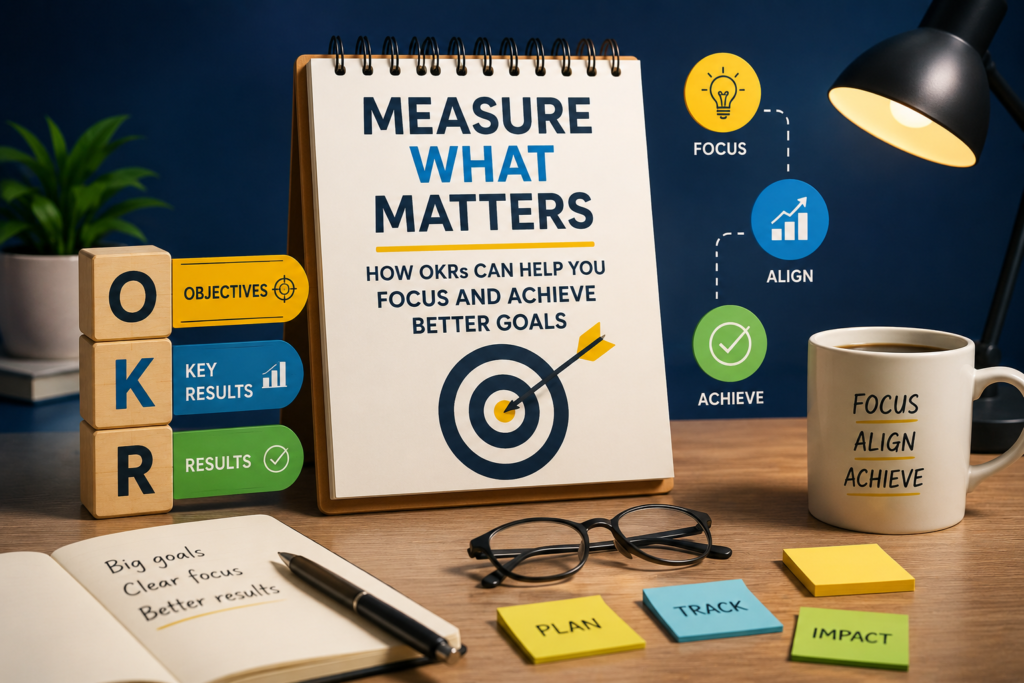
Editorial Note: This article is a summary and commentary on Measure What Matters by John Doerr. It is intended for educational and informational purposes, highlighting key lessons and practical applications from the book. The official What Matters site describes the book as John Doerr’s case for ambitious goal setting and careful execution through OKRs. This article is not official material from the author or publisher.
Introduction
Most people and organizations do not fail because they lack goals. They fail because they have too many goals, unclear goals, or goals that never connect to daily action.
Measure What Matters by John Doerr focuses on a goal-setting system known as OKRs: Objectives and Key Results. The idea is simple but powerful. An objective defines what you want to accomplish. Key results define how progress will be measured.
For readers interested in personal growth, productivity, business, and smarter decisions, this book matters because it teaches a practical way to move from vague ambition to focused execution.
Measure What Matters in One Sentence: Focus, Alignment, Tracking, and Learning
At its core, Measure What Matters is a book about turning ambition into a system. OKRs help you choose a meaningful objective, define measurable key results, review progress, and learn from what the results reveal.
The book’s practical value is not just that it teaches people how to set goals. Its deeper lesson is that goals only become useful when they influence decisions, priorities, conversations, and weekly behavior.
A simple way to understand the book is this:
Objective: What matters most right now?
Key Results: What evidence will show that progress is happening?
Check-ins: What do we need to learn, adjust, or stop doing?
This makes OKRs especially useful for people who feel busy but unfocused. Instead of adding more tasks, OKRs create a filter for deciding which tasks deserve attention.
Why This Book Matters
Modern work is full of distractions. Teams can spend weeks being busy without making meaningful progress. Individuals can work hard and still feel uncertain about whether their effort is moving them in the right direction.
The value of OKRs is that they create focus. They help people decide what matters most, measure progress, and stay aligned.
This is useful for companies, but it also applies to personal goals. Whether you want to grow a business, improve your career, build better habits, or complete a major project, you need clarity about what success looks like.
Why OKRs Work: The Research Behind Specific, Challenging Goals
OKRs work because they combine several principles that research has connected to better goal pursuit: specificity, challenge, measurement, feedback, and review.
In goal-setting research, Edwin Locke and Gary Latham found that specific, difficult goals consistently produced higher performance than vague “do your best” goals. Their review reported effect sizes ranging from .42 to .80 when comparing specific, difficult goals with “do your best” instructions.
This supports one of the central ideas behind OKRs: vague goals create vague effort. A goal like “improve productivity” may sound positive, but it does not clearly define success. A stronger OKR forces clarity:
Objective: Improve weekly execution on high-priority work.
Key Result 1: Complete three deep-work sessions per week for four weeks.
Key Result 2: Finish one priority project milestone by the end of the month.
Key Result 3: Reduce unfinished weekly tasks by 25%.
The research does not mean every goal should be extreme. It means goals need enough clarity and challenge to direct attention. OKRs give ambition a structure.
“An OKR is not a wish list; it is a promise to pay attention.”
Key Lesson 1: Clear Objectives Create Direction
An objective should be meaningful, specific enough to guide action, and important enough to deserve attention. A weak objective sounds like “do better.” A stronger objective sounds like “improve customer onboarding so new users understand the product faster.”
The objective gives direction. It answers the question: “Where are we going?”
In daily life, many people skip this step. They create tasks before they define purpose. As a result, they stay busy but scattered.
Before starting a project, ask: “What is the real outcome I want?” That question can prevent wasted energy.
Key Lesson 2: Key Results Make Progress Visible
Key results turn intention into measurement. They answer: “How will we know we are making progress?”
This matters because vague goals are easy to reinterpret. If the goal is simply “grow the business,” almost any activity can feel relevant. But if the key result is tied to a measurable outcome, progress becomes easier to evaluate.
For personal development, key results can be simple. If your objective is to become more consistent with learning, a key result might be completing a certain number of focused study sessions each week.
The point is not perfection. The point is visibility.
“A weak goal creates motion. A strong OKR creates evidence.”
The Practical Difference Between Objectives, Key Results, KPIs, and Tasks
One reason people struggle with OKRs is that they confuse goals, metrics, and tasks. These are related, but they are not the same thing.
| Term | What it means | Example |
|---|---|---|
| Objective | The meaningful outcome you want | Improve customer onboarding |
| Key Result | The measurable evidence of progress | Increase activation rate from 35% to 50% |
| KPI | A metric you monitor over time | Monthly churn rate |
| Task | An action you complete | Rewrite onboarding emails |
A task can support an OKR, but it should not replace the OKR. Google’s OKR guidance says key results should describe outcomes, not activities, and should include evidence of completion.
A weak key result sounds like this: “Launch a new onboarding guide.”
A stronger key result sounds like this: “Increase the percentage of new users who complete onboarding from 40% to 60% by the end of the quarter.”
The difference is important. The first example measures activity. The second measures whether the activity created a result.
OKR Examples You Can Adapt for Business, Career, Learning, and Personal Growth
Here are simple examples that show how OKRs can move from vague ambition to measurable execution.
| Situation | Objective | Key Results |
|---|---|---|
| Business | Improve customer retention | Reduce monthly churn from 6% to 4%; contact 30 at-risk customers; improve onboarding completion from 50% to 70% |
| Career | Become a stronger project leader | Lead one project from planning to delivery; collect feedback from three teammates; complete one project-management course |
| Learning | Build a consistent reading habit | Read 20 pages per day for 25 days; finish two books this month; write one-page notes for each book |
| Personal productivity | Protect focus during the week | Complete four deep-work blocks per week; reduce phone distractions during work sessions; finish the top priority task before noon three days per week |
| Content creation | Publish more consistently | Publish four articles this month; update two older posts; create one reusable content checklist |
The best OKRs are not just measurable. They are decision-making tools. If an OKR does not help you decide what to do next, it may be too vague, too crowded, or too disconnected from the outcome that matters.
Key Lesson 3: Focus Requires Saying No
One of the hardest parts of goal setting is not choosing what to do. It is choosing what not to do.
OKRs force prioritization. If everything is important, nothing is truly important. A team with too many priorities becomes slow and reactive. A person with too many goals becomes overwhelmed.
This lesson is especially useful for ambitious people. Wanting growth is good, but chasing every opportunity can dilute progress.
A strong question to ask is: “What goal deserves my best energy right now?” The answer helps you protect attention.
Key Lesson 4: Alignment Improves Team Performance
In organizations, OKRs help connect individual effort to larger priorities. When people understand how their work contributes to a bigger objective, they can make better decisions.
Alignment does not mean everyone does the same thing. It means everyone understands the direction.
For leaders, this reduces confusion. For employees, it creates meaning. For teams, it helps prevent duplicated work and conflicting priorities.
Even outside a formal workplace, alignment matters. Families, student groups, small businesses, and creative teams all benefit when people understand shared goals.
Key Lesson 5: Regular Check-Ins Keep Goals Alive
Many goals fail because they are written once and forgotten. OKRs work best when progress is reviewed regularly.
A check-in does not need to be complicated. It can include three questions: What progress did we make? What is blocking us? What needs to change?
This habit turns goals into a living system. It also reduces surprises. When problems are noticed early, teams can adjust before failure becomes expensive.
For personal goals, a weekly review can be enough. Look at your objective, review your key results, and decide what next action matters most.
How to Review OKRs Without Turning Them Into a Pressure System
OKRs work best when they create learning, not fear. Google’s OKR guidance notes that low grades should be treated as data for improving future OKRs, and OKRs should not be treated as employee evaluations.
A useful OKR review is not just a scoreboard. It is a conversation about reality.
Use this simple weekly review format:
| Review question | Why it matters |
|---|---|
| What changed this week? | Keeps the OKR connected to real progress |
| Which key result is moving? | Shows where effort is working |
| Which key result is stuck? | Reveals obstacles early |
| What did we learn? | Turns measurement into improvement |
| What is the next best action? | Converts review into execution |
Progress monitoring matters because it keeps goals visible. A 2016 meta-analysis found that interventions designed to increase progress monitoring improved goal attainment, with stronger effects when results were public or physically recorded.
The lesson is simple: goals are easier to ignore when they stay hidden.
“OKRs fail when they become a scoreboard for blame instead of a system for learning.”
How to Apply These Lessons in Daily Life
Start with one objective for the next month. Make it meaningful but realistic. Avoid choosing five goals at once.
Next, create two or three key results. They should be measurable and connected to the objective. If you cannot measure them, clarify them.
Then schedule a weekly review. Use the review to update progress and decide what needs attention.
Finally, keep your OKRs visible. Put them in a notebook, planner, task app, or workspace. Visibility increases commitment.
A 30-Day OKR Template for Turning the Book Into Action
Use this simple template to apply the lessons from Measure What Matters for the next 30 days.
Step 1: Choose one objective
Ask: What outcome would make the next 30 days meaningful?
My objective:
I will ____________________________________________.
Step 2: Choose two or three key results
Ask: What measurable evidence would prove that I made progress?
Key Result 1:
____________________________________________.
Key Result 2:
____________________________________________.
Key Result 3:
____________________________________________.
Step 3: Define the weekly review
Ask these three questions once per week:
What progress did I make?
What is blocking progress?
What should I change next week?
Step 4: Decide what to stop doing
OKRs create focus by forcing tradeoffs. Write down one thing you will pause, reduce, or say no to while this objective is active.
I will stop or reduce:
____________________________________________.
What Most People Misunderstand About OKRs
Many people think OKRs are mainly about measurement. Measurement matters, but OKRs are really about focus.
The goal is not to track everything. The goal is to identify the few outcomes that deserve attention now.
A second misunderstanding is that OKRs should become a long task list. Google’s OKR guidance specifically warns that OKRs are not a shared to-do list. Tasks are how you work. OKRs define whether the work is producing meaningful progress.
A third misunderstanding is that every OKR must be fully achieved. Some OKRs are committed goals, where success should be expected. Others are aspirational goals, where the purpose is to stretch beyond normal performance. Google’s playbook distinguishes between committed OKRs, which are expected to reach 1.0, and aspirational OKRs, which may average around 0.7.
This distinction matters because it prevents OKRs from becoming either too safe or too punishing.
“The power of OKRs is not tracking more things. It is choosing fewer things that deserve tracking.”
Common Mistakes to Avoid
A common mistake is creating too many OKRs. This defeats the purpose. Focus works because it limits attention to what matters most.
Another mistake is choosing measurements that do not reflect real progress. For example, measuring hours worked may be less useful than measuring completed outcomes.
A third mistake is using goals as a pressure tool instead of a learning tool. When people fear honest reporting, they hide problems. The best goal systems encourage transparency and adjustment.
FAQ Section
Frequently Asked Questions About Measure What Matters and OKRs
What is the main idea of Measure What Matters?
The main idea of Measure What Matters is that people and organizations perform better when they define what matters most, measure progress clearly, and review results consistently. The book teaches this through OKRs: Objectives and Key Results.
What are OKRs in simple terms?
OKRs are a goal-setting framework made of two parts: an objective and key results. The objective describes what you want to achieve. The key results define how progress will be measured. IBM describes OKRs as a collaborative framework for defining and tracking ambitious goals with measurable outcomes.
Are OKRs the same as KPIs?
No. OKRs are usually used to drive change, improvement, or focus. KPIs are metrics used to monitor ongoing performance. A KPI may appear inside an OKR, but the OKR gives the metric a specific direction and time frame.
How many key results should an OKR have?
A simple starting point is two to four key results for one objective. IBM’s OKR guidance recommends one clear objective with 2–4 key results.
Can OKRs be used for personal goals?
Yes. OKRs can be used for personal growth, career planning, learning goals, fitness consistency, creative projects, and financial habits. The key is to choose one meaningful objective and a few measurable results.
How often should OKRs be reviewed?
For personal goals, a weekly review is usually enough. For teams, OKRs are often reviewed regularly throughout a cycle so blockers, priorities, and progress are visible. Progress-monitoring research supports the value of reviewing and recording progress.
Should OKRs be tied to performance reviews?
Not directly. Google re:Work notes that OKRs are not synonymous with employee evaluations. This helps teams treat missed targets as learning data instead of hiding problems.
Final Thoughts
Measure What Matters offers a practical reminder: goals are only useful when they guide behavior. Ambition matters, but ambition without measurement can become noise.
For business leaders, OKRs can improve focus and alignment. For individuals, they can create structure for personal growth. The deeper lesson is that progress becomes more likely when you define what matters and review it consistently.
Apply This Today
Write one objective for the next 30 days.
Choose two measurable key results.
Schedule a weekly 15-minute progress review.
Recommended Reading
Measure What Matters by John Doerr.
Related Articles on Focus, Habits, and Growth
Mindset: Grit: How to Build Perseverance
Productivity: The Power of Habit: Building Better Routines
Mindset: Mind: Key Lessons for Growth
Finance: You Deserve to Be Rich: How to Think, Plan, and Grow Your Money