
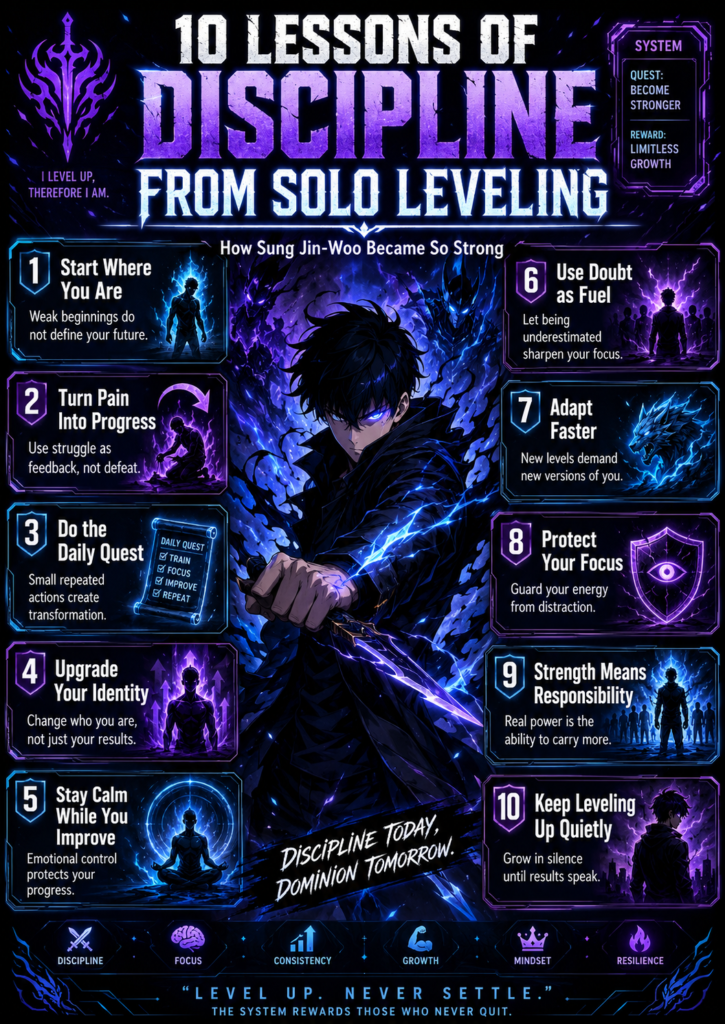
There is something addictive about watching a character rise from being underestimated to becoming almost impossible to ignore.
That is the power of Solo Leveling.
Sung Jin-Woo does not begin as the strongest person in the room. He begins as someone people doubt, dismiss, and quietly expect very little from. His story connects with people because it touches a familiar feeling: the frustration of knowing you could become more, while the world still sees you as less.
But Jin-Woo’s growth is not just about power.
It is about discipline.
Not the loud kind. Not the kind that needs applause. The kind that happens in silence, through repeated effort, painful adaptation, and the willingness to become a new version of yourself even when your old identity feels safer.
These Solo Leveling discipline lessons are not about becoming invincible. They are about learning how to grow when you feel behind, underestimated, or stuck at a level that no longer matches your potential.
Start Where You Are, Not Where You Wish You Were
Sung Jin-Woo’s journey begins from weakness.
That matters because many people delay growth until they feel ready, confident, talented, or respected. They wait for the perfect moment when they will finally feel strong enough to begin.
But growth does not usually start from confidence.
It starts from honesty.
You have to admit your current level without hating yourself for it. You have to see your weaknesses clearly without turning them into a prison. Jin-Woo’s beginning reminds us that being weak today does not mean you are destined to stay weak forever.
In real life, this may mean accepting that you are not disciplined yet, not skilled yet, not confident yet, not prepared yet.
That is not the end.
That is the starting point.
Discipline begins when you stop being ashamed of your current level and start taking responsibility for your next one.
Turn Pain Into Information
One of the strongest Solo Leveling discipline lessons is that difficulty can either break your identity or sharpen your awareness.
Jin-Woo suffers because his world is demanding, dangerous, and unfair. But instead of treating pain only as punishment, his growth comes from learning through pressure. Every struggle reveals something: a weakness, a limitation, a pattern, a necessary change.
Most people waste pain by only resenting it.
They go through failure, rejection, embarrassment, or pressure, but they do not study it. They only feel it. And because they only feel it, they repeat the same patterns again.
A disciplined person asks better questions.
“What did this teach me?”
“What did this expose?”
“What needs to change before I face the next challenge?”
Pain is not automatically wisdom. Pain only becomes wisdom when you reflect on it.
Do the Daily Quest
In Solo Leveling, the idea of repeated tasks is powerful because it reflects one of the simplest truths about growth: transformation is usually built through boring repetition.
Most people want the dramatic upgrade.
They want the visible result, the new confidence, the respect, the breakthrough, the final transformation. But they underestimate the daily quest — the small actions repeated when nobody is watching.
In real life, the daily quest might be reading, training, practicing a skill, improving your focus, studying, saving money, building your health, or becoming more emotionally controlled.
It does not feel epic every day.
Sometimes discipline feels ordinary. Almost too ordinary.
But the ordinary is where identity changes.
You do not become stronger because of one inspired moment. You become stronger because you repeatedly prove to yourself that you can keep a promise even when it feels inconvenient.
Upgrade Your Identity, Not Just Your Results
Sung Jin-Woo does not simply gain strength. His entire sense of self changes.
That is important.
Many people chase results without changing the identity behind those results. They want better habits, but still see themselves as lazy. They want confidence, but still talk to themselves like someone who is powerless. They want leadership, but still avoid responsibility.
Real change requires an identity upgrade.
You have to begin seeing yourself as someone who trains, someone who learns, someone who adapts, someone who does not quit at the first sign of discomfort.
This does not mean pretending to be perfect.
It means choosing a new internal standard.
The strongest transformation happens when your behavior is no longer just something you force yourself to do. It becomes part of who you are becoming.
Stay Calm While You Improve
Jin-Woo’s growth becomes powerful because he learns to observe, calculate, and respond instead of panicking.
This is a major lesson for real life.
When people feel behind, they often become emotionally chaotic. They compare themselves to others, rush decisions, overreact to setbacks, or abandon the process too early. Their insecurity makes them impatient, and their impatience makes them inconsistent.
Discipline requires calm.
Not because life is easy.
But because panic wastes energy.
If you are trying to improve your life, you need enough emotional control to stay with the process. You need to notice progress even when it is slow. You need to make decisions from clarity instead of desperation.
Calm people are not calm because nothing hurts.
They are calm because they have trained themselves not to let every feeling become a command.
Use Being Underestimated as Fuel, Not Poison
Sung Jin-Woo is underestimated often. But the interesting part is what he does with that experience.
Being underestimated can create two kinds of people.
One person becomes bitter. They spend all their energy trying to prove others wrong, but their identity remains trapped inside other people’s opinions.
Another person becomes focused. They use being overlooked as fuel, but they do not let it control their soul.
That difference matters.
It is natural to want recognition. It is human to want people to see your effort and respect your growth. But if your entire motivation depends on proving others wrong, you are still letting them hold the center of your life.
Discipline means turning rejection into energy without becoming ruled by resentment.
Let people misunderstand your beginning.
Your responsibility is to keep building the next version of yourself.
Adapt Faster Than Your Problems
One of the reasons Jin-Woo becomes stronger is that he adapts. He does not survive by using the same mindset forever.
This is one of the most practical Solo Leveling discipline lessons.
Many people struggle because they keep trying to solve new problems with old strategies. They face a bigger challenge but bring the same habits. They enter a new season of life but carry the same emotional reactions. They want higher results but keep the same standards.
Growth requires adaptation.
The method that helped you begin may not be enough to help you advance.
At one level, effort may be enough. At the next level, strategy matters. At one level, confidence may help. At the next level, emotional discipline matters. At one level, ambition gets you moving. At the next level, patience keeps you from burning out.
To grow, you must be willing to update yourself.
Protect Your Focus
Jin-Woo’s journey has a clear sense of direction. He is not casually wandering through his growth.
This is something many people lack.
They say they want to improve, but their attention is scattered everywhere. Their energy leaks into distractions, comparison, drama, random goals, and emotional noise.
Focus is not just concentration.
Focus is loyalty.
It is deciding what deserves your best energy and what does not. It is knowing which battles matter and which ones are only stealing your attention.
In real life, protecting focus may mean reducing distractions, saying no more often, avoiding unnecessary conflict, or creating routines that make growth easier.
You do not need unlimited motivation.
You need fewer things pulling you away from what matters.
Strength Comes With Responsibility
The stronger Jin-Woo becomes, the more responsibility he carries.
That is a mature lesson.
Many people want strength because they imagine freedom. They want money, success, influence, skill, confidence, or power because they think it will remove pressure from life.
But often, growth does not remove responsibility.
It increases it.
When you become more capable, more people may depend on you. Your choices matter more. Your discipline affects more than just your own comfort. This is true in leadership, family, career, and personal growth.
Real strength is not just the ability to do what you want.
It is the ability to handle what matters.
A strong person is not someone who escapes responsibility. A strong person becomes trustworthy enough to carry it.
Keep Leveling Up Quietly
Perhaps the deepest lesson from Solo Leveling is that not all growth needs to be announced.
Some of the most important changes happen quietly.
You work on yourself before people notice. You build habits before results appear. You become more disciplined before anyone respects the process. You change internally before the world updates its opinion of you.
That silent phase is where many people quit.
They want visible proof too soon. They want encouragement before they have built consistency. They want confidence before they have created evidence.
But the people who grow deeply are often willing to be unseen for a while.
They do the work without needing constant validation.
They understand that becoming stronger is not always dramatic from the outside. Sometimes it looks like waking up and doing the same important thing again, even when nothing feels different yet.
Final Reflection
Sung Jin-Woo’s strength is compelling because it represents something many people secretly want: the possibility of rising beyond the identity life handed them.
But the real lesson is not fantasy.
The real lesson is discipline.
Start where you are. Learn from pain. Complete the daily quest. Upgrade your identity. Stay calm. Adapt. Protect your focus. Carry responsibility. Keep leveling up even when nobody notices.
That is how real growth happens.
Not in one magical moment.
Not through motivation alone.
But through the quiet decision to stop living beneath your potential.
You may not control where you begin. You may not control who underestimates you. You may not control how difficult the next level feels.
But you can control whether you keep growing.
And sometimes, that is the difference between staying trapped in your old life and becoming someone even you did not know you could become.