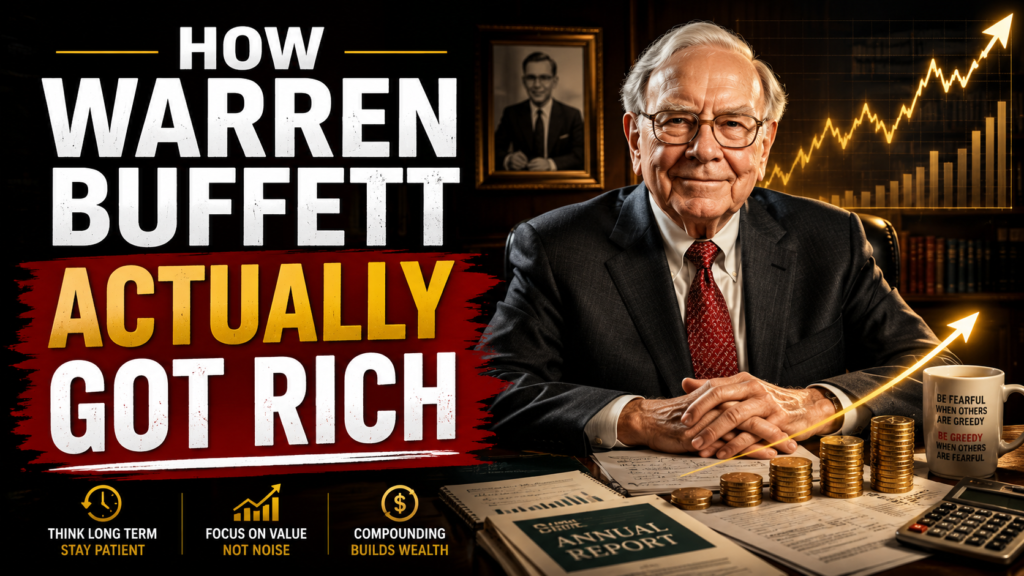
Warren Buffett is one of the most admired investors in modern financial history, not because he built wealth quickly, but because he built it patiently. Born in Omaha, Nebraska, Buffett became famous for turning value investing into a lifelong discipline: buying strong businesses at sensible prices, holding them for decades, and allowing compounding to do the quiet work. For many years, he led Berkshire Hathaway, transforming it from a struggling textile company into one of the world’s most respected business empires. In 2026, Greg Abel became Berkshire’s CEO, while Buffett remained chairman, marking the end of Buffett’s six-decade run as chief executive but not the end of his influence. His story matters because it shows that real wealth is rarely created by luck, noise, or constant movement. More often, it comes from patience, judgment, emotional control, and the ability to see value where others only see price.
He Started Early
Warren Buffett’s wealth did not begin with one magical investment. It began with an unusually early relationship with money.
He was interested in business as a child, and according to Investopedia, he bought his first stock at age 11 and made his first real estate investment at age 14. That matters because Buffett did not wait until adulthood to start learning how money behaves. He began making decisions, watching outcomes, and developing financial instincts while most people were still thinking of money only as something to spend.
The deeper point is not simply that he started young. Many people start young and still make poor decisions. Buffett’s advantage was that he treated money like a subject to study.
He learned that small amounts can become meaningful if they are protected and reinvested. He learned that mistakes are cheaper when you make them early. He learned that patience is not passive; it is a skill built through repeated practice.
For the article, you can explain it like this:
Buffett’s early start gave him more than extra years. It gave him extra feedback. Every investment, every mistake, every small business idea became part of his education. By the time many people were just beginning to understand money, Buffett had already spent years watching how capital grows, disappears, and compounds.
His first advantage was time.
His second advantage was curiosity.
His third advantage was learning from experience instead of only theory.
He Learned From Benjamin Graham
Buffett did not invent his investing philosophy from nothing. One of the most important turning points in his life was studying under Benjamin Graham at Columbia Business School. Graham is widely known as the father of value investing, and Buffett absorbed his central lesson: do not treat stocks like lottery tickets; treat them like pieces of real businesses.
Graham’s influence helped Buffett understand the difference between price and value. Price is what the market is offering today. Value is what the business is truly worth based on its assets, earnings power, durability, and future potential.
This changed Buffett’s entire approach.
Instead of asking, “Will this stock go up tomorrow?” he learned to ask:
“Is this business worth more than the market currently thinks?”
“Am I buying with a margin of safety?”
“Would I be comfortable owning this if the stock market closed for years?”
That last question is important because it separates investing from speculation.
A speculator needs constant price movement.
A value investor needs a business that makes sense.
For the article, this section can be stronger if you explain that Graham gave Buffett the foundation, but Buffett later evolved. Graham often searched for statistically cheap companies. Buffett eventually moved toward buying excellent businesses at fair prices, especially companies with strong brands, loyal customers, and durable competitive advantages.
So Graham gave Buffett the discipline.
Buffett added patience, quality, and scale.
He Bought Businesses, Not Just Stocks
This is one of the biggest reasons Buffett became rich.
Most people look at a stock and see a ticker symbol. Buffett looked at a stock and saw ownership.
When Berkshire owned Coca-Cola or American Express, Buffett was not just hoping that a line on a chart would rise. He was thinking like a partial owner of those businesses. He cared about the brand, the customer loyalty, the profits, the management, and whether the company could keep earning money for decades.
Berkshire’s 2025 annual report shows how powerful this ownership mindset became. At the end of 2025, Berkshire owned 9.3% of Coca-Cola, with a cost basis of about $1.299 billion and a market value of about $27.964 billion. That same year, Coca-Cola paid Berkshire $816 million in dividends. Berkshire also owned 22.1% of American Express, with a cost basis of about $1.287 billion, a market value of about $56.088 billion, and $479 million in dividends for 2025.
Those numbers are important because they show the difference between trading and owning.
A trader may buy Coca-Cola because they think the stock will move soon.
Buffett bought because he believed the business could keep producing value for a very long time.
That is why this section should focus on the mindset shift:
Buffett did not get rich by asking, “What stock is hot?”
He got rich by asking, “What business can keep producing cash, year after year, even when the economy changes?”
That is a very different question. And it leads to very different decisions.
He Used Berkshire Hathaway as a Wealth-Building Engine
Buffett’s biggest move was not only buying good stocks. It was transforming Berkshire Hathaway into a capital allocation machine.
Berkshire was originally a struggling textile company. Buffett eventually took control of it and used it as a vehicle to own businesses, buy stocks, collect profits, and reinvest capital. This was the real turning point because Buffett stopped being only an investor managing a portfolio. He became the leader of a company that could continuously move money toward better opportunities.
Berkshire became powerful because it had many sources of cash.
It owned operating businesses.
It owned insurance companies.
It owned public stocks.
It acquired private companies.
It reinvested profits instead of paying large dividends.
That structure allowed Buffett to do something very rare: keep capital inside the system and redeploy it for decades.
Berkshire’s 2025 letter says the company produced $46 billion of net cash flow from operating activities in 2025, compared with a five-year average above $40 billion. That cash generation is what gives Berkshire the ability to invest across its businesses and securities portfolio.
For your article, explain Berkshire like this:
Berkshire Hathaway became Buffett’s financial engine. Money came in from operating businesses, insurance premiums, dividends, and investment gains. Instead of being consumed or wasted, that money was redirected into more businesses and more investments. Over time, Berkshire became less like a normal company and more like a disciplined machine for turning cash into more cash.
That is why Buffett’s wealth is not only about stock picking. It is about capital allocation — the ability to decide where money should go next.
He Benefited From Insurance Float
This part is very important because many people misunderstand Buffett’s success.
Berkshire’s insurance businesses gave Buffett access to something called float.
Float is money that insurance companies collect in premiums before they eventually pay claims. For example, an insurance company may receive money today, but the claims connected to that money may not be paid until later. During that time, the company can invest the float.
Used badly, float can be dangerous. If an insurance company prices policies poorly, it may collect too little and later face huge claims. But used carefully, float can become a powerful source of investment capital.
Buffett understood this deeply.
Berkshire’s insurance operations were not just side businesses. They became central to the entire Berkshire model. The 2025 Berkshire shareholder letter says the company’s insurance operations aimed to grow underwriting profits and float in a disciplined way. It also reported a property and casualty combined ratio of 87.1% in 2025, which means the insurance operations were profitable before even considering investment income.
This is why float mattered so much:
Berkshire collected insurance premiums.
It invested the money while waiting to pay claims.
If underwriting was disciplined, the float could be low-cost or even profitable.
That gave Berkshire more capital to invest for the long term.
For the article, you can explain it in simple language:
Insurance float gave Buffett a pool of investable money. But the genius was not merely having float. The genius was combining float with discipline. Berkshire had to avoid reckless insurance underwriting, because cheap capital is only useful if it does not later become expensive trouble.
That is why Buffett’s insurance strategy was not gambling. It was patience supported by structure.
He Avoided Unnecessary Mistakes
Buffett became rich not only because of what he bought, but also because of what he refused to do.
He did not chase every trend.
He did not need constant action.
He did not rely heavily on debt.
He did not invest in businesses he could not understand.
He did not panic every time markets became uncomfortable.
This is less dramatic than finding a famous winning stock, but it may be even more important.
Compounding only works if you survive long enough. One massive mistake can erase years of progress. Buffett protected Berkshire by avoiding situations where one bad decision could permanently damage the company.
This does not mean he never made mistakes. He did. Even Berkshire’s 2025 report openly described its Kraft Heinz investment as disappointing, saying the return had been “well short of adequate.”
That detail is useful for the article because it makes Buffett more realistic. He was not perfect. His greatness came from keeping mistakes manageable and making sure his best decisions had decades to grow.
You can write it this way:
Buffett’s discipline was not only the ability to say yes to good opportunities. It was the ability to say no to thousands of tempting ones. In finance, refusing a bad opportunity can be just as profitable as finding a good one, because the money you do not lose remains available for the future.
That is one of the quiet secrets of wealth: avoiding ruin is part of getting rich.
He Let Compounding Do the Heavy Work
Compounding is the center of Buffett’s fortune.
Compounding happens when money earns returns, and then those returns begin earning returns too. At first, the effect looks slow. Later, it becomes enormous.
Berkshire’s own long-term performance shows this clearly. From 1965 to 2025, Berkshire’s per-share market value compounded at 19.7% annually, compared with 10.5% for the S&P 500 including dividends. Over the full period from 1964 to 2025, Berkshire’s overall gain was 6,099,294%, compared with 46,061% for the S&P 500.
The key is that Buffett did not interrupt the process.
Many people destroy compounding because they become impatient. They sell too early. They chase something more exciting. They panic during downturns. They take profits too quickly. They constantly move from one idea to another.
Buffett did the opposite.
He allowed strong businesses to keep working.
He allowed dividends to accumulate.
He allowed retained earnings to be reinvested.
He allowed time to magnify good decisions.
That is why Buffett’s wealth is not just a story about intelligence. It is a story about temperament.
A brilliant investor who cannot wait may never become truly wealthy. A patient investor with good judgment can allow time to do what effort alone cannot.