
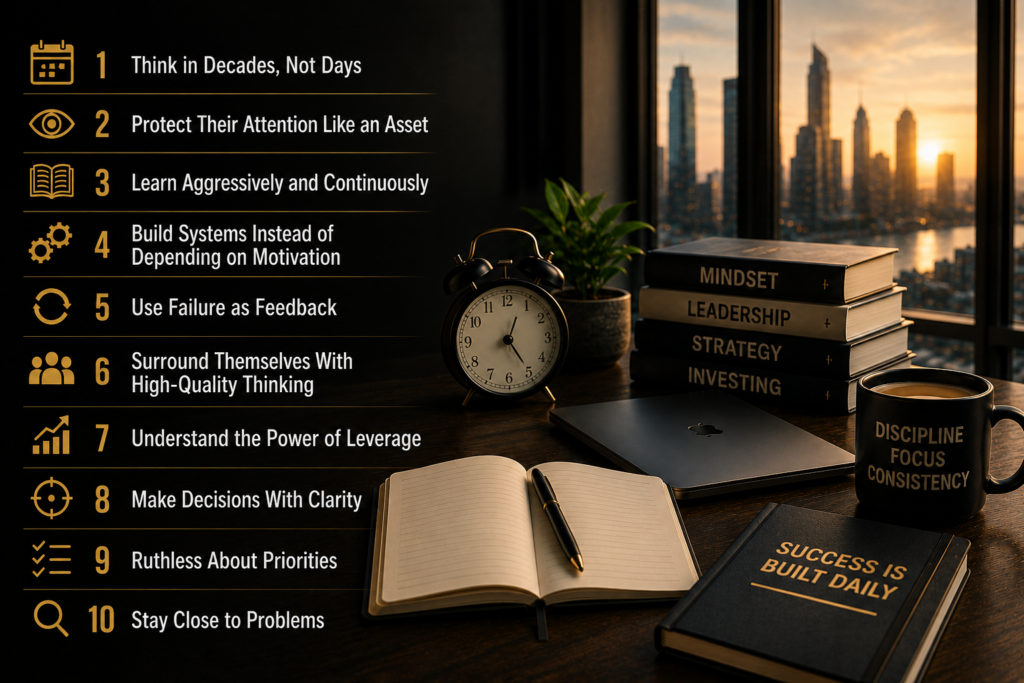
Editorial Note:Success rarely happens overnight. Behind extraordinary wealth and achievement are consistent behaviors practiced daily over many years. The habits explored in 10 Powerful Billionaire Habits for Wealth and Success are not magic formulas or shortcuts to riches — they are principles centered around discipline, long-term thinking, continuous learning, calculated risk-taking, and relentless focus.
Introduction
Most people look at billionaires and focus on the visible outcomes: the billion-dollar companies, the luxury homes, the private jets, the investments, and the headlines.
But extreme wealth is rarely built from visible moments alone.
Long before success becomes public, it is usually shaped by private habits repeated consistently over many years. Behind many highly successful entrepreneurs, investors, and business leaders is a different way of thinking about time, focus, risk, learning, and personal growth.
This is not about glorifying wealth or pretending billionaires are perfect. Money alone does not create wisdom, happiness, or character. But studying the habits behind high achievement can reveal useful lessons about discipline, productivity, financial success, and long-term thinking.
Because before success changes someone’s lifestyle, it usually changes how they think.
Think in Decades, Not Days
One of the most common billionaire habits is long-term thinking.
While many people make decisions based on immediate comfort, short-term pressure, or emotional reactions, highly successful people tend to think in longer timelines. They ask what a decision will mean five, ten, or twenty years from now.
This mindset changes everything.
It changes how they spend money, choose relationships, build businesses, learn skills, and handle discomfort. Instead of chasing quick rewards, they focus on actions that compound over time.
Wealth creation rarely happens overnight. It is usually built through years of strategic decisions that may look small in the beginning but become powerful with consistency.
The average person often asks, “What do I want right now?”
The long-term thinker asks, “What will my future self be grateful I did today?”
Protect Their Attention Like an Asset
Money is not the first resource successful people learn to protect.
Attention is.
In a world full of notifications, social media, entertainment, opinions, and constant noise, focus has become one of the most valuable skills a person can develop. Billionaires and high performers often understand that attention shapes outcomes.
If your attention is scattered, your results become scattered.
This is why many successful people create strong boundaries around their time. They reduce distractions, avoid low-value conversations, limit unnecessary meetings, and create space for deep thinking and meaningful work.
One hour of focused thinking can be more valuable than ten hours of shallow busyness.
Most people protect their phones better than they protect their minds. High achievers do the opposite.
Learn Aggressively and Continuously
Another powerful billionaire habit is continuous learning.
Many wealthy entrepreneurs and successful investors remain deeply curious even after achieving major success. They study markets, technology, leadership, psychology, negotiation, consumer behavior, and emerging trends.
They do not assume that what worked yesterday will keep working tomorrow.
This matters because the world changes quickly. Industries evolve. Technology disrupts old systems. Customer behavior shifts. New opportunities appear while old advantages disappear.
Successful people keep updating their thinking.
They read, ask better questions, study failure, speak with smart people, and look for patterns others miss. They are not just consuming information; they are building judgment.
Knowledge compounds like money. One insight can lead to a better decision. One skill can open a new opportunity. One idea can change an entire business.
Build Systems Instead of Depending on Motivation
Motivation is unreliable.
Some days you feel focused, confident, and ambitious. Other days you feel tired, distracted, or uncertain. Billionaire-level success cannot depend on emotional energy alone.
Highly successful people build systems.
A system is a structure that helps you keep moving even when motivation fades. It can be a routine, a schedule, a hiring process, a financial plan, a decision framework, or a habit that makes progress easier.
Most people rely on mood. They work hard when they feel inspired and slow down when life becomes uncomfortable.
High performers try to make progress less dependent on emotion.
They create routines, measure what matters, delegate, automate, remove unnecessary decisions, and build environments where the right actions become easier to repeat.
These habits may not look exciting from the outside. But consistency often creates extraordinary results.
Use Failure as Feedback
Most people experience failure as a personal verdict.
They fail at something and quickly turn it into identity: “I am not good enough,” “I am not smart enough,” or “Maybe this is not for me.”
Successful people tend to relate to failure differently.
They still feel frustration and disappointment, but they are more likely to treat failure as information. Instead of asking why the failure happened to them, they ask what the failure can teach them.
What went wrong?
What assumption was false?
What needs to improve?
What did the market reject?
What should change next time?
This mindset keeps them moving.
Failure becomes feedback instead of permanent defeat. It allows them to recover faster, adapt faster, and make better decisions in the future.
Every major success usually contains failed attempts that outsiders never see.
Surround Themselves With High-Quality Thinking
Your environment quietly shapes your ambition.
Spend enough time around people who complain, avoid responsibility, and think small, and your own standards can begin to shrink. Spend time around builders, creators, entrepreneurs, and disciplined thinkers, and growth starts to feel more natural.
Billionaires often seek proximity to high-quality thinking.
This does not mean they only spend time with wealthy people. It means they value people who challenge assumptions, ask better questions, think clearly, and raise the standard of what is possible.
Conversations influence mindset more than most people realize.
The right environment can expand your vision. The wrong environment can quietly limit it.
One of the most underrated success habits is learning which rooms help you grow and which rooms keep you small.
Understand the Power of Leverage
Hard work matters, but hard work alone rarely creates massive wealth.
Leverage does.
Leverage means getting a greater result from the same unit of effort. It is the difference between only trading time for money and building something that can grow beyond your personal hours.
There are many forms of leverage: capital, technology, media, teams, brand, knowledge, systems, and ownership.
This is why many billionaires focus on building assets instead of only earning income. They create businesses, products, platforms, investments, or intellectual property that can continue producing value over time.
The average person asks, “How can I earn more per hour?”
The leverage-minded person asks, “How can I create value that is not limited to my hours?”
That question changes everything.
Make Decisions With Clarity
Many people lose years to indecision.
They overthink, delay, ask everyone for opinions, wait for certainty, and avoid taking responsibility. But waiting too long can become its own form of failure.
Successful people are not perfect decision-makers, but they often develop clearer decision habits.
They gather information, evaluate risk, make a choice, act, and adjust when necessary.
This matters because clarity often comes from movement. A decision creates feedback. Feedback creates learning. Learning improves the next decision.
Not every decision requires endless analysis. Some choices need caution, but others simply need momentum.
The future rarely reveals itself to people who wait. It reveals itself to people who engage with it.
Ruthless About Priorities
A person can do many things, but not all things.
Billionaires and high performers often become extremely skilled at identifying what matters most. They understand that success is not about doing more. It is about doing the right things with intensity.
Every yes contains a hidden no.
Yes to distraction is no to focus.
Yes to everything is no to excellence.
Yes to comfort may be no to growth.
This is why successful people often protect their schedules carefully. They are not casually available to every opportunity, trend, or request.
Focus creates force.
A flashlight spreads light. A laser cuts through steel. The difference is concentration.
Stay Close to Problems
Billionaires are often problem hunters.
Where many people complain, they investigate. They look for friction, inefficiency, wasted time, unmet needs, and broken systems.
This habit is one of the reasons entrepreneurs discover opportunities others miss.
A frustrating experience may reveal a business idea. An inefficient process may reveal a market gap. A common complaint may reveal demand for a better solution.
Most people experience problems emotionally. Builders experience problems as signals.
The bigger and more persistent the problem, the more valuable the solution may become.
The world is full of opportunities hiding inside ordinary frustrations. The trained mind notices them.
Final Thoughts
The real habit beneath all these billionaire habits is responsibility.
Highly successful people may not control everything. Luck, timing, background, health, and opportunity all matter. But high achievers tend to spend less time obsessing over what they cannot control and more time improving what they can influence.
They focus on their decisions, habits, mindset, skills, environment, and execution.
Not everyone will become a billionaire, and a meaningful life does not require extreme wealth. But the habits behind wealth creation and long-term success can still help anyone think more clearly, work more intentionally, and grow more consistently.
Success usually becomes visible only after personal transformation has already happened quietly in the background.
Internal Link Suggestions
Productivity: Getting Things Done: Simple Ways for Stress-Free Productivity
Finance: Money for Couples: Building a Shared Financial Life
Business: The Lean Startup: How to Build Better Ideas with Less Risk
Mindset: Secrets of the Millionaire Mind: Money Mindset for Building Wealth Awareness